The importance of the multifunctionality of civil liability
Downloads
Abstract
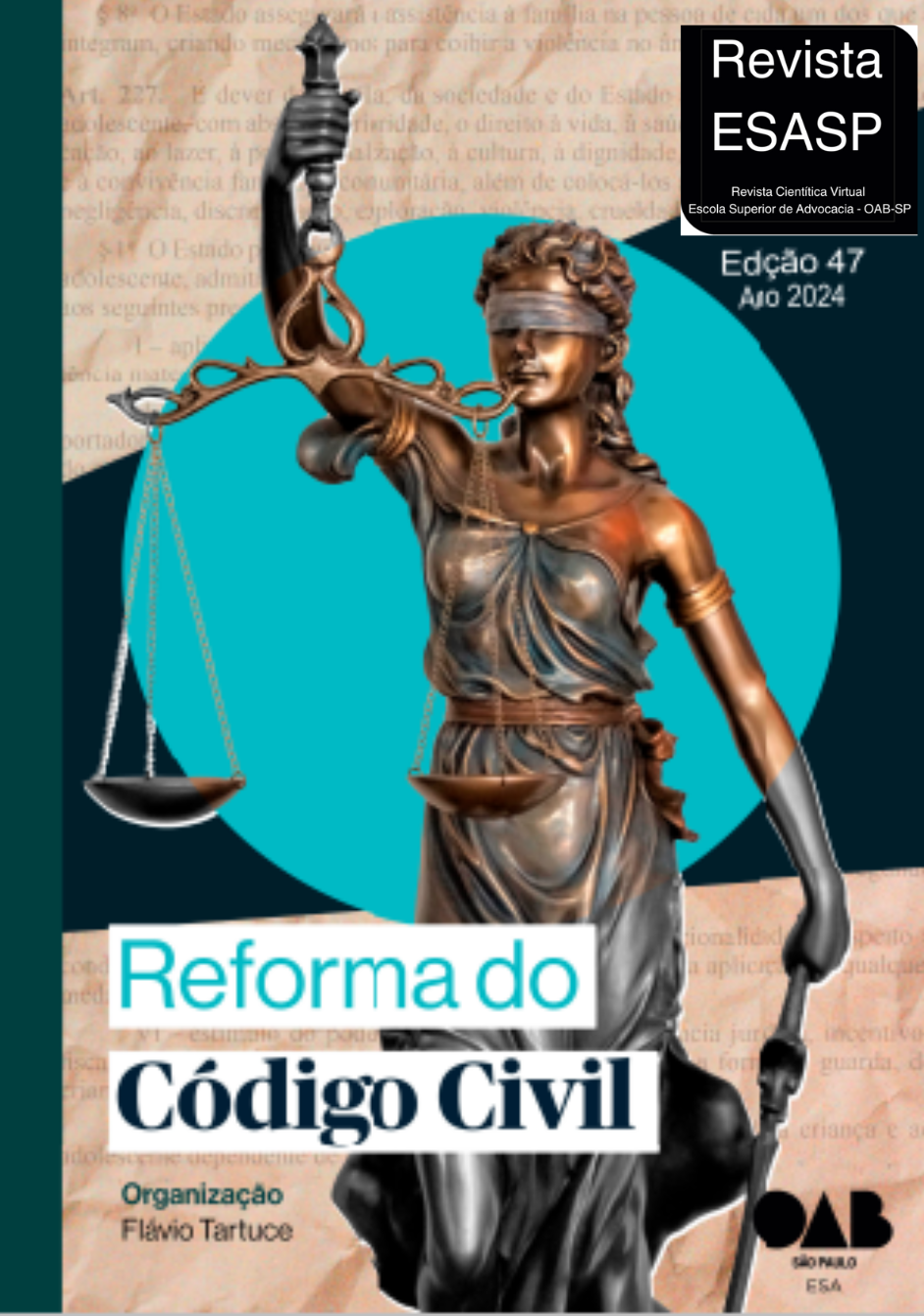
The article addresses the proposed amendment to the Brazilian Civil Code, advocating for the transition from a monofunctional (reparatory) model to a multifunctional model of civil liability. It emphasizes the importance of the preventive function and positive protection as mechanisms for social regulation, legal certainty, and rights protection in a society marked by technological advancements and social transformations.
Received in: July 2024 | Accepted in: October 2024
Keywords
References
BOBBIO, Norberto. Da estrutura à função: novos estudos de teoria do direito. Tradução de Daniela Beccaccia Versiani. Barueri: Manole, 2007.
MORAES, Ana Beatriz; LOPES, Carlos Eduardo. A Função Preventiva da Responsabilidade Civil no Direito Brasileiro. Rio de Janeiro: Forense, 2020.
MORAES, Maria Celina Bodin de. Danos à pessoa humana: uma releitura civil-constitucional dos danos morais. 2. ed. Rio de Janeiro: Ed. Processo, 2017.
PERLINGIERI, Pietro. O direito civil na legalidade constitucional. Rio de Janeiro: Renovar, 2008.
RIBEIRO, Mariana Souza. Responsabilidade Civil: Aspectos Reparatórios e Sancionatórios. Belo Horizonte: Del Rey, 2021.
ROSENVALD, Nelson. As Funções da Responsabilidade Civil. 4. ed. São Paulo: Saraiva, 2022. E-book.
SILVA, João Carlos. Multifuncionalidade da Responsabilidade Civil: Uma Análise Contemporânea. 2. ed. São Paulo: Editora Revista dos Tribunais, 2022.
TEPEDINO, Gustavo; SCHREIBER, Anderson. As penas privadas no direito brasileiro. In: SARMENTO, Daniel; GALDINO, Flavio (org.). Direitos fundamentais: estudos em homenagem Ricardo Lobo Torres. Rio de Janeiro: Renovar, 2006.
VENTURI, Thais Goveia Pascoaloto. Responsabilidade civil preventiva: a proteção contra a violação dos direitos e a tutela inibitória material. São Paulo: Malheiros, 2014
How to Cite
License

This work is licensed under a Creative Commons Attribution 4.0 International License.
This journal provides immediate open access to its content, based on the principle that making scientific knowledge freely available to the public supports a greater global exchange of knowledge.
All articles are published under the Creative Commons Attribution 4.0 International License (CC BY 4.0), which permits unrestricted use, distribution, and reproduction in any medium, provided that the original work is properly cited.