About the Journal
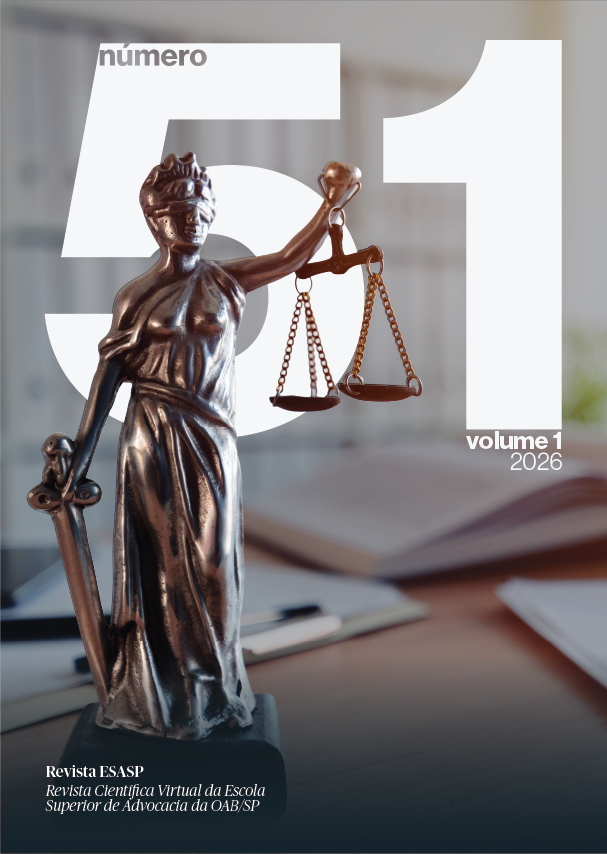
Welcome to Revista ESASP - Revista Científica Virtual da Escola Superior de Advocacia da OAB/SP
Founded in 2009, the ESASP Journal is a Diamond Open Access scientific journal operating on a continuous publication model. Committed to excellence, academic rigor, and ethical integrity, the journal serves as a qualified platform for the dissemination of legal knowledge, with no submission or article processing charges (APCs), contributing to the democratization of access to scientific production.
Mission and Scope
The ESASP Journal aims to foster contemporary legal debate through the publication of original research of high scientific relevance, contributing to the critical development of legal scholarship in Brazil and in dialogue with the national and international academic community.
Its editorial scope focuses on the analysis of legal phenomena in their multiple dimensions, with an emphasis on critical, interdisciplinary, and transversal approaches that connect Law to current political, economic, technological, and social challenges. The journal prioritizes studies examining the interactions between Public and Private Law, as well as the impacts of institutional transformations, international dynamics, and digital innovations on legal systems, including issues related to Human Rights and Socio-Environmental Justice.
The journal’s thematic breadth is supported by a multi-level editorial structure composed of an Editor-in-Chief, Executive and Associate Editors, and a Scientific Editorial Board with consultative and deliberative functions, including scholars affiliated with national and international institutions. This structure ensures the proper distribution of editorial responsibilities and coherence between the journal’s scope and its scientific evaluation capacity.
The continuous submission flow is managed rigorously by the editorial team, which conducts initial screening (desk review), assigns manuscripts to specialized reviewers, and oversees the editorial process through to final decision. The Scientific Editorial Board supervises academic guidelines and consolidates editorial policies, ensuring that published works meet high standards of quality, relevance, and scientific integrity.
In this way, the ESASP Journal ensures that its thematic diversity is supported by consistent editorial governance, capable of sustaining scientific rigor, transparency in editorial processes, and the academic relevance of its publications.
Editorial Policy and Scientific Rigor
The journal adopts a Double-Blind Peer Review system, ensuring impartiality and academic quality. Its editorial workflow follows transparency guidelines and best practices in publication ethics recommended by COPE (Committee on Publication Ethics). The journal publishes original articles (empirical or theoretical), academic essays, and critical reviews, serving as a reference space for undergraduate and graduate (lato and stricto sensu) researchers.
Indexing and Visibility
The ESASP Journal is indexed in important national and international directories and databases, such as Google Scholar, Miguilim, LatinREV, and ROAD, reaffirming its commitment to expanding visibility and democratizing scientific knowledge. All content is licensed under the Creative Commons Attribution 4.0 International (CC BY 4.0).
ISSN: 2175-4462
Fees: None (Diamond Open Access)
Periodicity: Continuous Publication
History: Published continuously since 2009.
Transparency and Archiving Statement
To ensure historical integrity and digital preservation, retrospective issues (2009–2022) are available in a digital archive on ISSUU. Since 2023, the journal has adopted the OJS (Open Journal Systems) platform for editorial management and long-term digital preservation.
Announcements
Current Issue
The ESA Journal presents its new issue to the academic and legal community, structured around two axes of profound relevance to understanding the country’s institutional and social dynamics. In keeping with its editorial commitment to fostering plural and rigorous debate, committed to the effectiveness of fundamental rights, this issue brings together research devoted both to assessing the first decade of the 2015 Code of Civil Procedure and to critically examining the role of law in the reproduction and overcoming of racial hierarchies.